How to leave this world?
It's a strange world we live in here. Everything goes on as usual: people go to work, to school, to university, to the supermarket, to the zoo, to the movies, to parties, to the kunstverein, back home. They plan their future, move house, buy cars, buy pets, buy apartments, have children, build houses, retire.
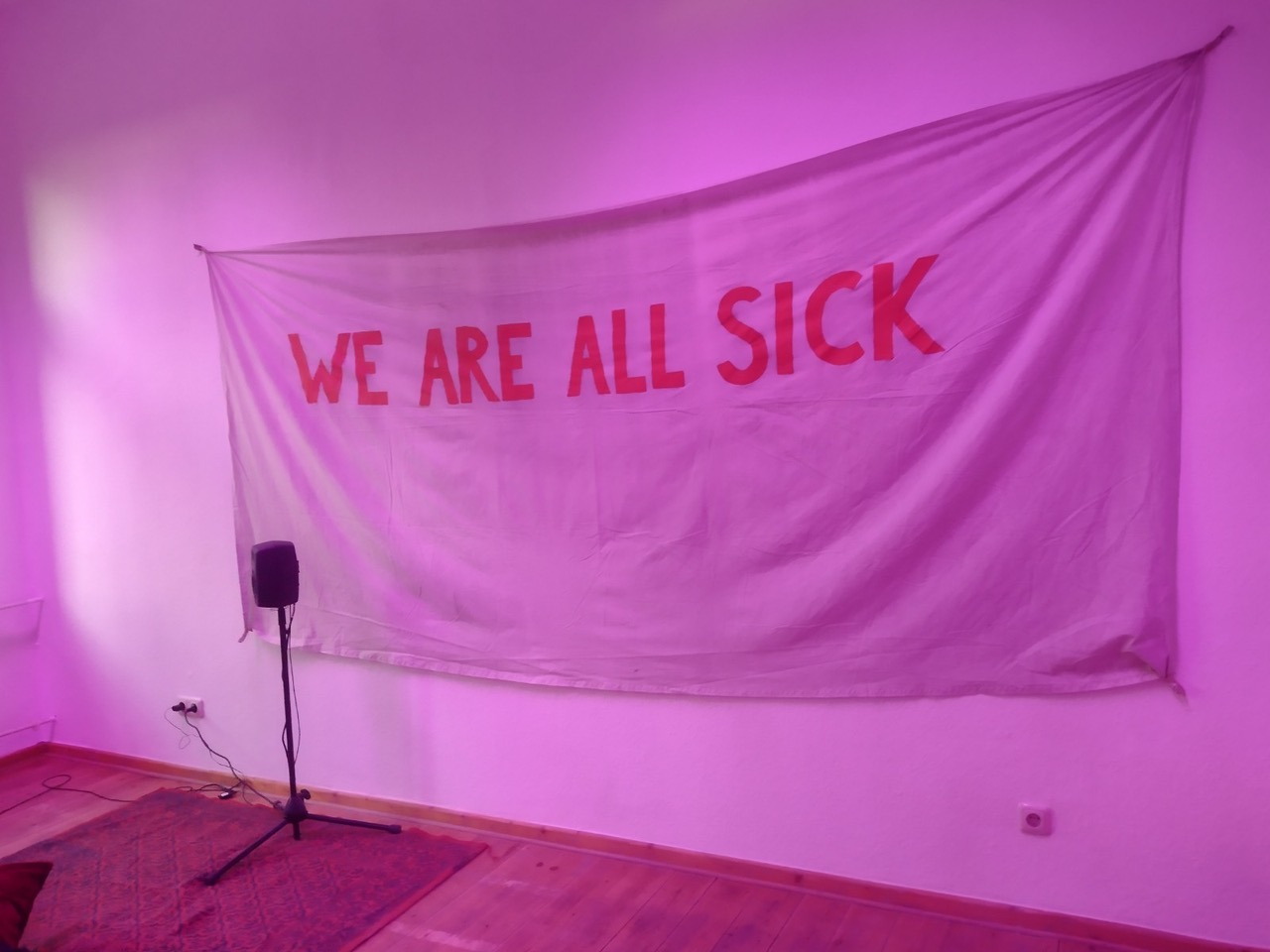
At the same time, for some time now, actually for a very long time now, it has become increasingly clear, that this so-called normality is being built on an abyss of contradictions, crises, overloads, states of emergency, depressions, catastrophes and exclusions.
The list of ongoing wars and armed conflicts in Syria, Ukraine, Palestine and Israel, in Sudan or in the Congo, the Covid-19 pandemic, the steadily worsening crisis in the financial and labor sectors as well as the climate change that is taking place all the time in the background on an increasingly massive and rapid scale, while at the same time the demand for fossil fuels continues to rise, only appear to be the latest events and developments in a series that reaches far into the past. These events and developments are now increasingly revealing the structural crisis, if not catastrophic nature of this way of being in the world and treating it here in Europe, perhaps in the very heart of darkness - a realization that has been experienced in other parts of the world in the most terrible way on an every day level for over 500 years.
How can we continue to live in and with this way of treating the world that creates crises and disasters? Without denying that it is also a part of our being, our way of thinking and acting? Without succumbing to the temptation of escapism, closing our minds and trying not to think about it? Without taking refuge in naturalizing simplifications such as: That's just the way it is, eat or be eaten.
And how does this apply in particular to working and living with and in the art field? Because this is where we work and live, this is where we speak from - from a position that is also involved in all of this. What roles do art spaces and the actors working in these conditions play? What functions do they fulfill, what tasks do they have within them? And what about the ideas and phantasms of autonomy, freedom, creativity, criticism, resistance and romanticism that are substantially associated with art and artists? And what about discussions about all this – are they possible, are they sought for and do they continue? Or are they more about clear positioning, fixed opinions and exclusions?
In a way, the undertaking How to leave this world? follows on from the series Kunstraum in der Katastrophe (Art spaces in the catastrophe) from summer 2023. This time, however, we are more in search of concrete ways of exiting, of leaving, of abolishing this way of making the world and less interested in criticizing, reforming or improving it. We hope that this will lead to more concrete actions, other experiences and thus other perspectives - hopefully completely different perspectives.
How to leave this world? consists of an exhibition, perhaps more of a spatial situation, and a number of events and workshops taking place in it: the space of the Kunstverein will be filled with a video from Marwa Arsanio's series Who is afraid of Ideology?, Jakob Jakobsen's letter of resignation from being a professional artist and an audio piece about it, as well as an Abolish-Strike-Dream-Archive-Altar-Bar, which will also host three reading evenings (on Human Strike, Dreams and Fantasy as Critical Practice, and Communization and the Abolition of Gender), which in turn will end in bar evenings. At the opening there will be a discussion between Kathy-Ann Tan, Jakob Jakobsen, Birte Heier and Sebastian Stein on working and living conditions in the art world, leaving it and the background to Wie bloß diese Welt verlassen? Furthermore there will be an event on exits, strikes and canceling. At the beginning of May, we will spend two weeks attempting to abolish the Kunstverein with KVL. During this time, there will also be a participation by Mattin. And finally, we are organizing a talk with the activist group Letzte Generation.